My wife and I just returned from a river cruise in Holland and Belgium. It far exceeded our expectations, but not in the way you might expect.
Oh, we saw working windmills, brilliant tulips, magnificent medieval architecture, and churches that predated Columbus. We were wined and dined by the best cruise company in Europe: Viking. Our complaints were few, and our praises were many. It was a magical trip.
Our senses were alive with the vibrant sights of colorful tulip farms, the abundance of bicycles, and the delightful tastes of stroopwafels, poffertjes, and appeltaarts.
Our walking tours burned off most of the calories. Or so I convinced myself.
Most of these engaging memories will likely fade over time or be told in more extravagant ways. However, there are a few memories that are etched into my heart forever. That’s the subject of this post.
Stumbling Stones
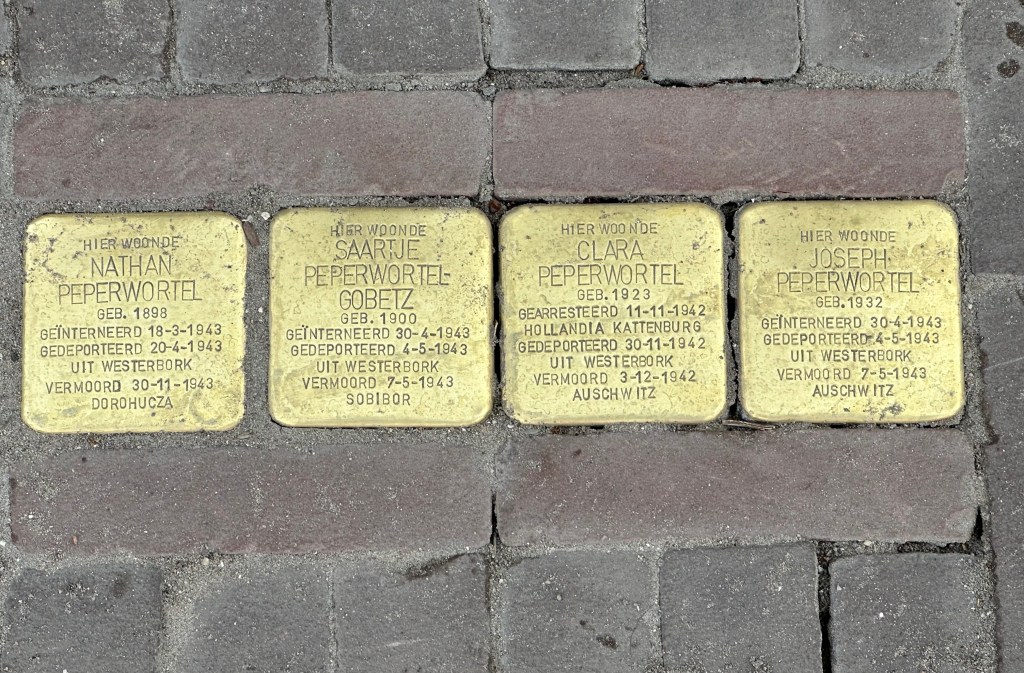
Any tourist visiting Amsterdam knows about one of its most famous landmarks — the home of Anne Frank. A Jewish Holocaust victim, her story has been recounted in books and films. However, what is less known is how cities in Europe have embraced the concept of a decentralized monument to the Jewish victims of World War II.
Initiated by German artist Gunter Demnig, “Stumbling Stones” are small copper plaques the size of cobblestones embedded in the sidewalk just high enough that one might “stumble” and look down. Placed in front of the last known freely chosen residences of the victims, these 10×10 cm flat “stones” are engraved with the victim’s name, date of birth, where they were deported, and when they were executed. Currently, over 70,000 such stones have been installed in more than 1200 cities throughout Europe.
Every step in Amsterdam holds the potential for a sobering reminder of man’s inhumanity to man.
The Crossing
We had just finished our walking tour of Nijmegen when the guide pointed to a nearby bridge. The Oversteek Bridge, known as “The Crossing,” holds special significance for the people of this Dutch community, located just a few miles from the border with Germany. On September 20, 1944, units of the US 82nd Airborne paratroopers crossed the River Waal in a daring raid as part of Operation Market Garden. The city was liberated from the Nazis at the cost of 48 American lives.
The city of Nijmegen has never forgotten that sacrifice.
Dutch children learn about the history of World War II operations from a young age in school. When the Oversteek Bridge was constructed in 2013, officials in Nijmegen incorporated 96 streetlights – 48 pairs – into the bridge design, one for each American soldier who lost their life during the crossing.
Every night at sunset, the lights on the bridge illuminate pair by pair at the pace of a slow march, beginning on the south bank of the river and moving north, the same direction the soldiers paddled in their canvas dinghies during the daring operation to capture Nijmegen’s bridges from the Germans and retake the city.
One soldier, Private John Towle, was posthumously awarded the Medal of Honor for his efforts during the Battle of Nijmegen. The Dutch city even named a street and a local elementary school in his honor.
What makes this recognition even more remarkable is that nine months before the city’s liberation, American planes accidentally bombed the town center, killing hundreds of people, including children. Yet, to this day, the people of Nijmegen have embraced that catastrophic error as just that — an error. They see it as no reason not to honor the brave American soldiers who liberated them in September 1944.
But wait, there’s more.
Grave Adoption
In Maastricht, we had just finished another captivating walking tour of the Old Town, known for its medieval-era architecture and vibrant cultural scene, including the Gothic-style church Sint Janskerk and the Romanesque Basilica of St. Servatius. As we stood in the square at the heart of Old Town, our tour guide shared a personal story.
In 1945, her grandmother lived beside the land given by the Dutch to the Americans for a cemetery to bury 8,288 of their dead. The local Dutch were so grateful to the Americans that they immediately campaigned for locals to adopt one of the graves. Her grandmother was so touched that she was among the first to adopt one. Today, these thankful Netherlanders, to honor their sacrifice of the fallen, continue to bring flowers to the cemetery at least twice a year and research the life of the service member whose grave they have adopted. When she died, her grandmother passed her responsibility to our guide’s mother, who in turn passed that responsibility on to her upon her death.
Our tour group stood in stunned silence as we listened to her story. Thoughts of windmills and tulips vanished while our hearts struggled to contain our emotions and fully grasp the words we had just heard. Finally, someone asked, “Are all the graves adopted?” Our guide smiled. “Yes, and there is a 40,000-person waitlist to adopt any graves that become available.”
Our latest trip to Europe came with the expectation of savoring the cultural history of the Netherlands and Belgium. Yes, I’ll always remember the windmills and tulips. However, it is the unexpected moments, the surprising lessons of history that will linger long within my soul — I’m not sure I’ll ever forget Stumbling Stones, The Crossing, and the adoption of American graves by grateful Netherlanders.
Such memories shine more brightly than any tulip ever could.
 TheBuddyBlog.Com
Leave a comment